Home > Media Centre > Salam Online > The Pipe that Connects Us: PRP9 Pipeline Replacement
Published on February 26, 2026
Out in BSP’s West Asset, reliability isn’t just a performance target – it’s a necessity. When crude oil exports depend on infrastructure laid across kilometres of seabed, the smallest integrity concern can turn into a production risk. And for West Asset, one pipeline in particular sits at the centre of that equation: the export route connecting facilities from offshore Ampa to the onshore Seria Crude Oil Terminal (SCOT). This is the main oil line under the West asset, integral in carrying crude oil from its Fairley and Ampa fields back onshore.
That pipeline has long been one of the silent workhorses of the asset. But time, operating demands, and environmental exposure eventually will take a toll and poses a question: how long can it safely continue?
It was a call to action – to protect production continuity, concentrate investment where the risk was real, and strengthen the long-term resilience of a critical export route.
And thus, the PRP9 pipeline replacement project was put in place.
Building the New Lifeline
The scope was ambitious in distance and demanding in execution. The replacement covered approximately 26 kilometres offshore from Ampa to destination, followed by an additional 0.14 kilometres onshore from to SCOT. The new export line was designed from DN300 carbon steel pipeline, built to meet both integrity assurance and operational requirements for years ahead.
But the job wasn’t only about laying pipe. Installation also included a new riser at the northeast side of Ampa riser platform, ensuring the new system could integrate cleanly with the existing platform infrastructure. A riser is a vertical pipe that connects subsea pipelines or wells on the seafloor to a surface facility, such as the Ampa platform.
The execution plan followed a disciplined sequence: pre-installation surveys, the crucial landfall beach pull, pipelaying, riser installation, subsea spool installation offshore – in anticipation of upcoming activities such as offshore and onshore tie-ins at Ampa and SCOT, then testing, pre-commissioning, and final commissioning.
Each stage had to land perfectly — because in offshore work, one misstep doesn’t just slow progress, it multiplies risk.
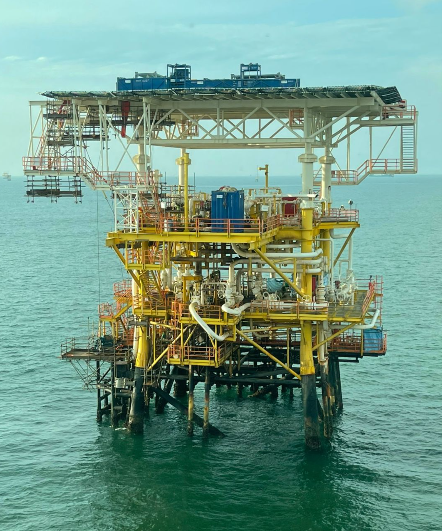
Preparation on platform prior to riser installation was done. Clamps installed above water by topside team. Subsea clamps were installed by divers from HYSY295.
Where Sea Meets Land: The Beach Pull
If the project had a defining moment, it was the beach pull.
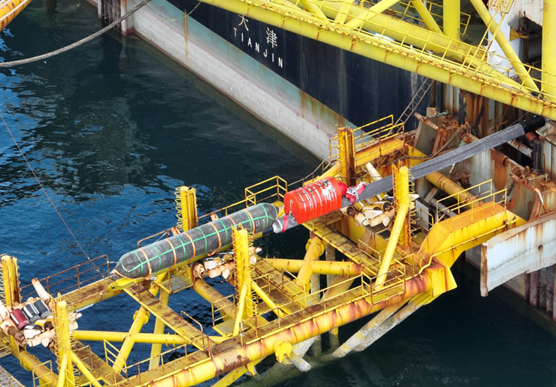
Pipeline and pullhead on stinger with black and orange floaters attached, ready for beach pull.
This is where offshore installation and onshore construction meet in the most direct way possible. The operation involves pulling the offshore pipeline section from the nearshore seabed across the shoreline, before we can lay the onshore pipeline. Sounds straightforward until reality hits: tides shift, weather windows shrink, environmental constraints tighten, and every move must remain controlled and safe.
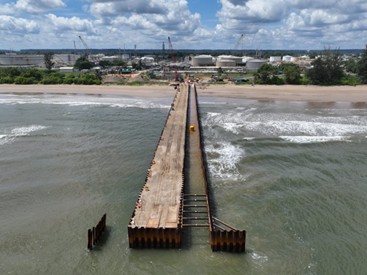
Cofferdam constructed with length of 170m. Cofferdam is a temporary structure built to ensure the required depth can be achieved for the beach pulling.
This phase required precise coordination and timing. It wasn’t just a technical task – it was a high-stakes bridge between two execution environments, demanding absolute alignment from all teams involved.
Safety as the Non-Negotiable
PRP9 was executed in an environment full of competing pressures: Simultaneous Operations (SIMOPS), vessel movement, lifting operations, and ever-changing offshore conditions. Yet safety wasn’t treated as a “priority” that shifts depending on the schedule – it was the foundation the schedule was built on.
Clear exclusion zones were enforced during marine operations. Weather limits were applied for critical lifts and pulling activities. Beach pull and tie-ins were guided by step-by-step procedures, strengthened daily through toolbox talks and permit-to-work alignment.
The result says more than any poster ever could: the project was completed with zero Lost Time Injuries — a reflection of disciplined execution and strong safety leadership across the field and supporting teams.
Heavy Metal, High Precision
Specialised vessels and equipment did the heavy lifting. Pipelay barge HYSY202 and Diving support vessel HYSY295 which have specialized tools, were supported by the rest of the marine spread, totalling to 13 vessels being mobilized for this project.
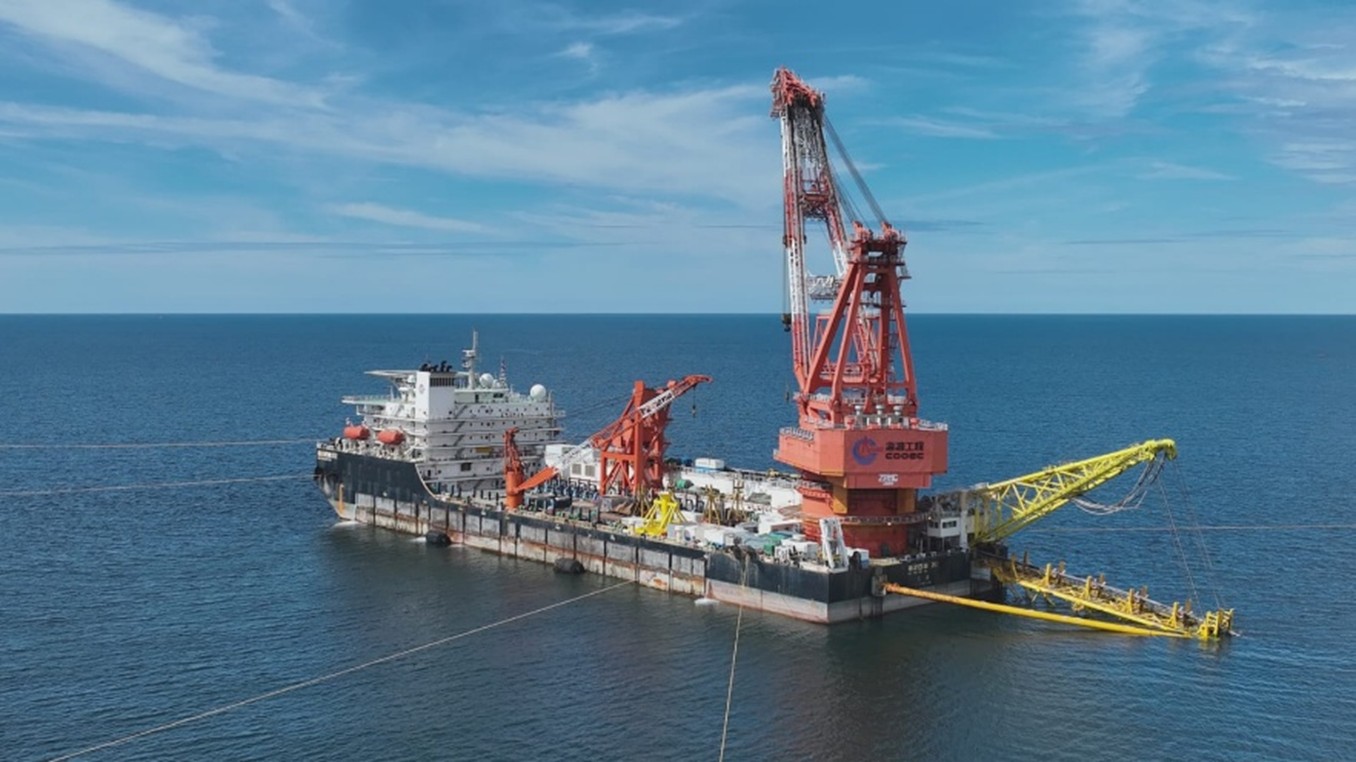
HYSY295 pipelay barge with the yellow stinger down during the pipelaying activities.
Continuous monitoring and responsive decision-making allowed the team to adapt without compromising standards. That balance – flexibility without losing control — is often what separates smooth delivery from costly disruption.
One Team, One Outcome
PRP9 Pipeline Replace Project success was built on integration. Engineering and pipeline teams worked alongside marine operations, construction, surveyors, commissioning, HSSE, and assurance functions — aligning especially during critical phases like the beach pull and brownfield tie-ins where offshore and onshore timing had to match exactly.
The project also created meaningful local workforce opportunities, strengthening hands-on capability in marine operations, pipeline installation, and brownfield execution. That experience is an investment of its own — one that will continue to pay off well beyond PRP9.
The Impact: More Than Replacement
In the end, PRP9 delivered more than a pipeline. It delivered confidence.
The replacement strengthened the reliability of a critical export system, improved production assurance, reduced long-term operational risk, and supported asset life extension in line with BSP’s strategy. It also reinforced something equally important: BSP’s ability to execute complex offshore-to-onshore projects safely, efficiently, and to high integrity standards.
PRP9 pipeline replacement may have started as an integrity need, but it finished as a clear statement of capability: the West Asset’s export lifeline is secure, and the teams behind it are stronger than ever.
PRP9 was about protecting West Asset’s export lifeline. Replacing this pipeline reduces long-term risk, strengthens production assurance, and gives us confidence in the integrity of a critical system for years ahead.
|
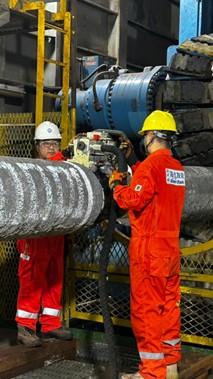
Non destructive testing at its station, to look for defects. Any defects would be repaired onboard. |
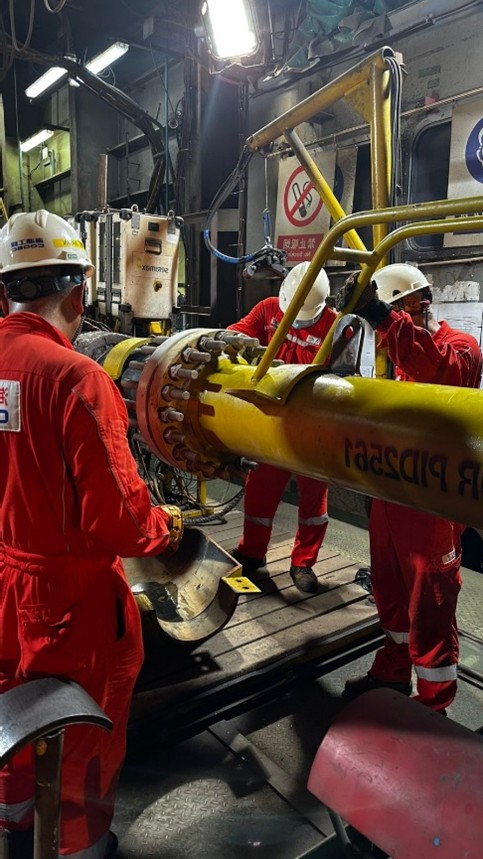
Pipeline pullhead connected to the end of the pipeline. This would be attached to the wire prior to beachpull. |